Greetings to all. This article was written by me and with the help of Professor Shohreh Javadi, and it was published in the Art and Civilization of the East magazineVolume 9, Number 34Winter 1400 pages28-15 has been published. May it be fruitful for artists and students.
abstract
Eslimi is one of the most important motifs in Islamic art decorations, which according to evidence and works reaches at least to the Sassanid era. Although some researchers have interpreted some forms of Pichan as Eslimi and said that it dates back to ancient Greece and Rome, based on the motifs left behind. In Iran, the spread of Islamic motifs began in the Seljuk period and reached its peak in the Safavid period. The purpose of this research is to investigate the evolution of Eslimi over time and to introduce the oldest examples of this role in Iranian decorations. Also presenting examples of Islam that went from Iran to other parts of the Islamic world. In this research, the method of historical-analytical research was through the collection of information and library documents of text and images. In this regard, study and The review of the book "Salimi and Nishanha" has been considered. Since contradictions and ambiguities about Salimi's role are stated in this book. In the present research, with a historical and documented perspective, new points have been raised and it has been clarified and corrected the wrong and inaccurate cases.
Keywords
Salimi, criticism, recognition, Sasanian, Safavid.
Introduction
Islamic designs are one of the most important and common decorative elements in all arts and are considered to be important motifs in Islamic art. Western researchers encountered this pattern for the first time in Arab lands and thought these motifs were Arabic and called it "Arabesque, which means Arab-like and Arab".
While after some time they realized that these motifs have nothing to do with Arabs and have their roots in Sassanid and Hellenic art. In the art of the Hellenistic period, these motifs have a naturalistic color of plant motifs, but in the Islamic period, they were abstracted and their variety increased. However, the greatest use and diversity of Islamic motifs was in the Safavid era (Hayat Nusaid, Eskandaripour Khorami, 1397, 2).
The purpose of this research: Since the introduction of this role, like many other cases, was first told by Westerners, and seeing the art of the Islamic era, first in Arab countries and then in Iran, with their limited information, they wrote some points that later became popular in Iran with not very accurate and sometimes wrong translations. Therefore, it was necessary to review the definition and rooting of Eslimi's role, which has been documented in this research. Because in one part of this book, he does not consider Eslimi's origin to be earthly and this world, and attributes it to an abstract role and to the transcendental world, while elsewhere in the same work, he talks about the world of nature and Eslimi's inspiration from nature. Therefore, the necessity and goals of this research is to provide accurate information with authentic visual documents regarding the historical roots of this role and remove the veil of ambiguities and false information and sometimes emotional and poetic interpretations.
Questions about Salimi's role:
- Where did the origin of Eslimi's role begin? can
- On what basis are the contents of Eslimi's book and signs written?
Research background
Islamic motifs, which are known as Arabic and Islamic designs, and are apparently one of the innovations of the Islamic era. But this design was more or less used before the advent of Islam, and some writers have also mentioned this and pointed out its presence in the art of different regions.
Georges Marse, the author of the book Islamic Art, mentioned some of its types originating from Hellenistic (Greek) decorations. In the great encyclopedia of Larus, arabesque is attributed to the Roman Empire and revived in the Italian Renaissance period: "The painters and sculptors of Pompeii limited the borders of the rooms and door jambs to arabesque. These ornaments must have become common again with the Italian Renaissance" (Zamani, 1352, 21). It follows from this description that every flower and bush image is called slimy.
The plant motifs that were executed in the Sassanid period on various works later formed the basis of the plant motifs of the Islamic period, especially the beginning of Islam, which were taken from the Sassanid art, which itself owes to the Achaemenid and Parthian art, which has a completely plant-based element, and the opinion of some artists is that this pattern is influenced by the Achaemenid congress leaf (Isfahani, Safaei, 1395, 34).
In the introductory book on the aesthetics of Islamic art written by Oliver Liman, he believes that Islamic art has unique designs mainly It does not exist and is not considered a religious art (Lyman, 2015, 40).
Simin Daneshvar has attributed Islamic designs to the Sasanian period: "European artists call these designs Arabesque, which does not seem to be the right term because these designs are not Arabic. And the fact that it has become known as Islamic designs is from the point of view that the artists of the Islamic era preferred and repeated these types of designs that existed in Iran since ancient times, because these designs did not conflict with the religious prohibition of creatures. These types of designs date back to Sasanian times" (Zamani, 1352, 21).
Dr. Dimand, the author of the Islamic Crafts Manual, considers the scroll arabesque to be related to the Sassanid period: "Here, one of the main characteristics of the Torik forms of Islamic crafts is observed, which is the combination of half a palm leaf and its branch. Palm leaf scroll motifs and similar designs of the Sassanid period are exemplary and examples of the works and early buildings of the Islamic period, which can be seen in the Al-Mashti Palace, the pulpit of the Qiravan Mosque, and the marble capital of Syria" (ibid., 21).
apparently The news of the great encyclopedia of Laros and the opinion of Simin Daneshvar and the statement of Demand does not contradict the note of Georges Marse because the Roman Empire, according to the existing writings, was the heir of ancient Greek traditions and Sasanian art, in the opinion of some art historians, was influenced by the methods of Hellenic art. The age of ancient Greece has also been common in most civilized countries (Zamani, 1352, 22).
With the rise of the Seljuqs (429-590 AH) in Iran, a new chapter in decorative arts began. In this period, many decorative motifs that were invented in the previous periods reached the level of perfection. Salimi pattern is the most important decorative element that became popular in this period (Khazaei, 1375, 141). It is obvious that during the time of Ilkhans, there was a role of Eslimi in decorations.
After that, in the Timurid period, the role of Eslimi can be seen in tile works. and the continuation and spread of Islamic types to the open Safavid period becomes; As many decorative arts and motifs reached their peak in the Safavid era.
Since many materials have been written about Eslimi and they are mostly similar to each other and refer to old sources, and so far there has been no reference to the historical course of this role in a documentary form, and the format of the materials about Eslimi has been formed based on the opinions of Westerners and the interpretations of traditionalists, or the old popular saying that many plant motifs have been called Eslimi. Therefore, the present study introduced Eslimi and showed its historical course in a documentary form with pictures and also reviewed the book about Eslimi. In fact, he introduced Eslimi and demystified what has been and is common so far, and this is the first time that such an article is presented about Eslimi, which hopefully will be a reference for all artists, students, and respected professors who are willing to analyze, review, and reflect on this role.
Theoretical foundations of research
These motifs have appeared with natural origin. The created forms are a simple perception of the natural forms around humans, which is called geometry taken, this perception of nature continued in the later periods and was paid more attention during the Islamic era (Wilson, 1997, 1998). In Musaheb's Persian encyclopedia, it is stated: "Eslimi is one of the important components of Iranian stylized designs, composed of spiral curved lines that are designed in the field of tiling, plastering, etc." (Mosaheb, 2007, 576). This interpretation also introduced all kinds of plant motifs with twists and turns as slim, which is not true.
Arabesque1Farangi and Islami is an Arabic word, the first Arabic meaning is "attributed to Arab" and the second meaning is Islamic "attributed to Islam", and therefore Arabesque and Islamic design means a design that is attributed to Arabs and Muslims or invented by them or used by them. This decorative design, often vegetal, is used in almost all the works of the Islamic era and can be considered a factor of artistic unity and unity in the Islamic world and can be placed in a position such as Arabic calligraphy. At the same time, this design is not a purely Arabic or Islamic decorative theme, but also pre-Islamic It has been common in different countries, especially Iran (Zamani, 1352, 17). This article, like other comments about Eslimi, is not accurate and it is a general meaning of plant motifs.
Art historians consider Eslimi's patterns to be taken from the manifestations of nature such as flowers and leaves of trees, which they have summarized in order to avoid simulating and simulating (competing with the creator) (Azmi et al., 1392, p. 19).
In the case of simulating humans and animals, there was a ban on the image of early Islam, which does not include plant motifs. To simplify and summarize - sterilization - actually shows the taste and aesthetics of Iranian artists from the earliest times, who, due to special attention to nature (based on naturalist beliefs and opinions), depicted natural elements in the surrounding environment in a special and simple way in a geometric format.
A review of Eslimi's book and signs
In the mentioned book written by Eskanderpour Khorrami, we are faced with inconsistencies in the text, which is written in the form of a 25-page introduction, which does not have a page number, and with The letters of the alphabet are marked from C to E. And the rest of the 497 pages of the book presents a variety of slime images (image 1). Eslimi's book and emblems have been reviewed and criticized for this reason. In this work, it is pointed out to collect materials from the opinions and opinions of Westerners, especially the range of traditionalists, and since these topics are ambiguous and include emotional and illogical interpretations, it was necessary to criticize and analyze these materials with regard to the introduction and historical roots of Eslimi's role.
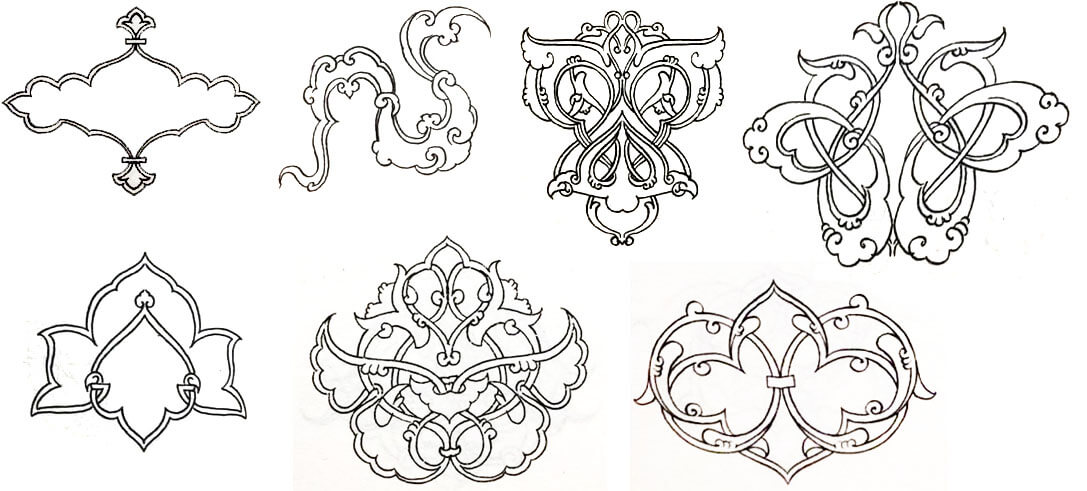
Image No. 1: A sample of the images of the Slime book and emblems, from page 25 onwards to the end of the book, page 497, which comes without any explanation or introduction of the types of Slime. Source: Iskanderpour Khorrami, 1397.
In the first stage, the contradictions in the contents of the book are mentioned, and then criticism and responses to the mentioned cases are given. According to the available documents and evidence, the writings of this book in the interpretation and analysis and symbology of Salimi's role have been fragmented and sometimes poetic and emotional interpretations and with philosophical and mystical terms of Western traditionalists, which have no logical and principled basis. Among the things quoted in this book are the following, which are first quoted from the book and then criticized.
"Throughout the Islamic and Khatai motifs, one does not deal with the material and tangible world, but in it, one can find a spiritual and exemplary world that is beyond the physical world" (Iskandarpour Khormi, 1397, p. "Salimi does not leave anything in the world of face and appearance to be an example for him; A mysterious form that represents the most unedited mathematical-abstract drawings" (ibid., p. "In the face and appearance of slimy to cedar2Mand bows his head in the circle of existence and shows bowing and submission" (ibid. T.).
In the first interpretations, it was said: Eslimi is not like any material form and this world, and has a mysterious and abstract shape, while in the next pages, Eslimi is compared to Saru, who has a bent stature, which is a sign of submission and contentment in the ring. These two completely opposite interpretations, one derived from nature and the other attributed to mysticism and poetic simile. Such contradictions have created ambiguity and unfortunately, these ambiguities have been fueled in the articles and courses of art fields for years.
In many parts of this book, vague and incomprehensible descriptions and sentences are used, which ultimately do not provide any point to the audience, and logical analysis of the roles is not done. Among them: "Sacred art in the Islamic period, which reached a certain height, made its flourishing manifestations more obvious in this period, but its secrets are still in the dark and there is a lot of discovery, intuition and study from different perspectives. In any case, not the westerners and sometimes not the easterners, still the mystery of beauty and charm They are not surprised. In Islamic art, these intertwined and twisted motifs are an image of the celestial world and also a reduced form of that infinite world; The Muslim artist gave another form to that great world in the smallest world of his screen and drew it to the earth by means of circles that have a planetary rotation system in its base, and drew this continuous celestial movement in earthly forms and in the widest circles surrounded by the earth, that is, the center of human life, up to the earth itself" (ibid., 6).
These poetic descriptions and sentences, sometimes taken from Islamic philosophy and mysticism, have nothing to do with the art and artistic motifs of the Islamic era. But unfortunately, it has been years since the translation of the opinions of this group of western and eastern theorists has become widespread and the spread of these delusions has hit the root of the truth and reality of the arts of the Islamic era! These doubts have been answered in several articles and a serious and documented criticism has been made on these opinions.3
"This noble art based on its eternal and proud document, which is eternal and has no beginning and end, with Its spiritual support has a special place among all nations and peoples" (ibid., Z). With what document is this title stated? How is it eternal and has no beginning or end? In case, with a little research and study on the motifs, both in terms of design and in terms of its historical roots, you can find out its beginning and end. Of course, this range of theorists refers to circular or spiral twists and turns, which they attribute to the beginning and completion of creation, and sometimes they raise the issue of plurality in unity in this regard. Of course, these interpretations have no logical and justified position.
"The quality of Islamic painting in a world freed from the shadows and representations of the material world and manifested in the light of color, gives it such an alchemy of form and color that everything takes on the color of absolute light. In the art of illumination, which is the pinnacle of this feast of light, the colors create a harmonious and harmonious collection in a wonderful harmony of shapes and forms, in a symbolic repetition, and open the doors of a world full of secrets, which cannot be revealed in this audience. This light is dependent on the manifestation of truth and everything in their existence is dependent on light. In this feast of light, a fascinating space has been created, suspended luminous figures located in nowhere; It means a place that is not located in a specific place, but is somewhere in the middle of nowhere; It is both the center and the environment; It is both inside and outside; It is for this reason that everything in it is infinitely surprising and full of freshness" (ibid., Q). In the painting, which is a description of scenes from poetry and literature, war and peace, hunting, stories of sultans, lovers, etc. are depicted in the same way in all scenes is
"Thus, at the forefront of Islamic arts, sacred motifs with rich and extensive images that contain thousands of shapes and patterns appear as the most unpretentious and beautiful art and display a world that is an invitation to poverty: single motifs, while full of motifs, are poor in material designations and full of expression, full of silence; The silence that amazes a person; The astonishment that is the result of observing all the glory and splendor of existence" (ibid., Q). These poetic sentences have a place in mystical and philosophical interpretations and have nothing to do with artistic motifs.
"All slimy curves have an inward face and an outward face; This is the essence of Islam, an inward tendency and an outward tendency, both of which have an infinite direction, and this is a representation of eternal behavior in art" (ibid., p. This claim is completely wrong because the direction is used in slime design and it is never used simultaneously from two directions (inward and outward) for slime design and slime band. All these interpretations Those who attribute art forms to philosophical and mystical thoughts originates from the same point of view and is rooted in the attitude of Westerners who explain Islamic art and architecture with Hindu, Buddhist and Christian theoretical foundations and also introduce decorative patterns and forms as strange, incomprehensible and wrong.
"Salimi" comes from the root of the word "Salama" which means reconciliation, peace and health. Salam is a prayer word derived from Tazi, which means "Bhi" to say hello to someone, it means to be healthy and harmless, and "Salam" is tahit wazandesh, greeting, salutation, good, wellness, bowing and honoring. "Islam" has also been interpreted with the root of submission, submission is to Haqqani's commands, and "submission" has also been interpreted as a place for reconciliation. (Ibid., z).
"Salam" is named in Dehkhoda's dictionary as a tree that is very healthy and has healing fruits" (ibid., z). "Salam: the name of the tablet on which the scribes write; Or read something and practice and recite it in Arabic. (Ibid., z). According to this book and The meanings used for the root of Eslimi, the only most logical and concrete definition of Eslimi can be considered as the name of a tree mentioned in the dictionary of Dehkhoda.
In another part, "Islamic is a motif that was perfected by adapting the motifs of the Manichaeans, Mithras, and Zoroastrians in the Islamic period, and that heavenly motif was attributed to this period, and it regained the health of its face and continued its fulfillment" (ibid., i). In the proof of this text, no visual document has been provided that which Manichaean, Mithraic and Zoroastrian figures were the source of Islam? Further, according to the claim that Eslimi existed from the past, what is Eslimi's relation to Islam? And there is also a tradition that Hazrat Ali (A.S.) drew the first Islami, which does not seem logical either.
Examining the role of Eslimi
Throughout the 25-page text of this book, suspicious quotations, vague hints and criticisms were also presented. Search and research about the decorations of the buildings of the early Islamic era, including the ancient buildings of Siraf, Simreh and Dar Neishabur (Tepe Madrasa, Tepe Sabz Pushan), Neh Gonbad Mosque of Balkh, Masjid Nayin, Niriz Mosque and Samara Mosque were discussed and Islamic motifs were introduced in the decorations of these buildings. What is discussed in this part of the research is the background of the motifs, which due to the similarity to the works of the Sassanid period, can be considered as a continuation of the Sassanid art, and the result is that the Islamic motif was in art before Islam, but it was most used in the Islamic period, which evolved and diversified over time. We witness the greatest transformation and prevalence of Islam in the Safavid period. The collected images show the existence of Islamic motifs in a basic form and two branches in prominent motifs, which evolved in the Islamic era.
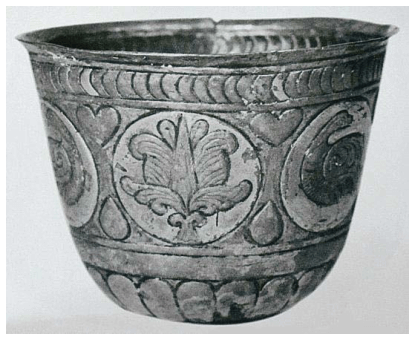
Image number 2: Simin cup decorated with plant motifs, 5th-6th century AD, Sassanid art, source: G, Lukonin, 1394, 151, in this image, a two-branched leaf from which a cedar has emerged.
In picture number 3, this pattern has been interpreted as a palm leaf, which is more similar to an artichoke or acanthus leaf that has cuts. In the translation of books that are available There are mistakes and ambiguities in this yogurt, but in terms of form, it is close to today's Eslimi.
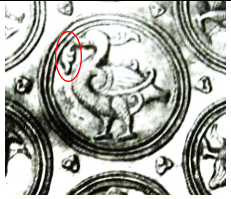
Image number 3: Sassanid metal plate, a bird with a palm leaf in its beak, source: Mohammadi, Dini, 2017
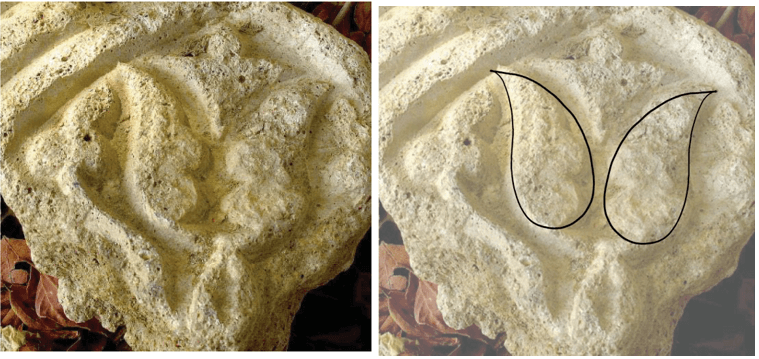
Image No. 4: A prominent plant pattern with decorations - preserved in Siraf's moza, two bent cedar patterns or bate jake can be seen, which are the same size, Source: Panjebashi, Dolab, 2016
In the early works of Islamic buildings, almost until the Seljuk period, the leaf-shaped motif can be seen, and after that it was seen in the works of Ilkhans. The leaf-shaped motifs, which are often two branches, can be attributed to the early slime, or it is a model for the formation of slime and its diversity in later times.
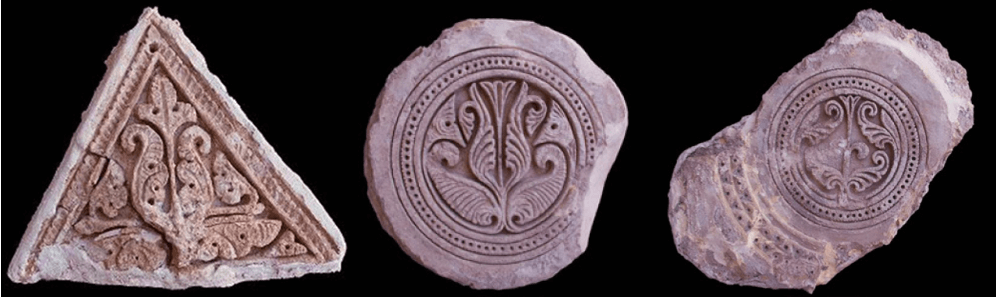
Image No. 5: Vegetal motifs, plaster decorations of Simre Mosque, source: Lak Pora 2009
In this stucco, two leaves can be seen at the bottom in a horizontal form and two leaves in between them in a vertical form, which are the type of congressional leaves known as artichoke or acanthus. This form of roles can be used as examples At first, it was considered Eslimi, although they were not called Eslimi at that time (picture 5).
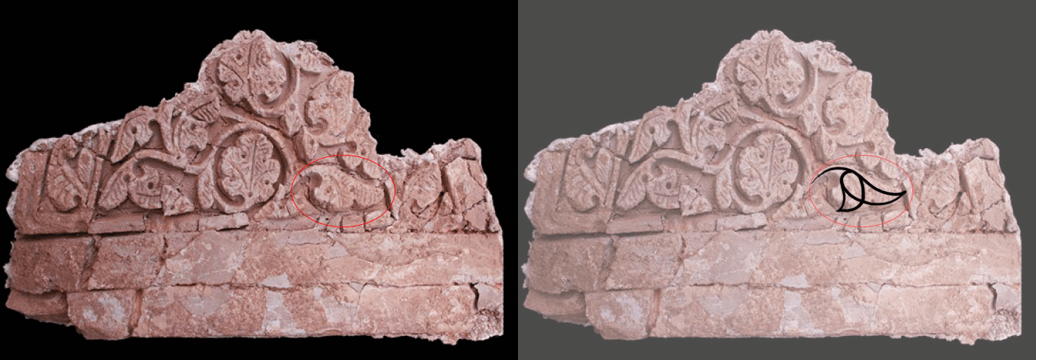
Picture No. 6: Vegetal motifs, plaster decorations of Simre Mosque, Salimi motif can be seen in it, source: Lak Pora 2009
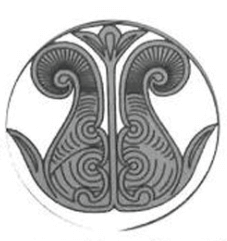
Picture No. 7: Plastering of Simre Mosque, Eslimi's pattern can be clearly seen, source: Lek Pora 2009
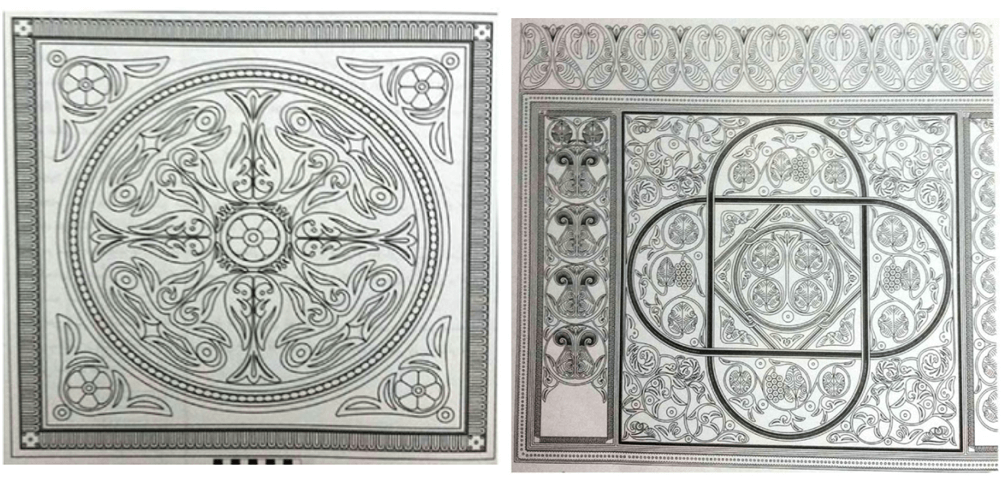
Picture number 8: Simreh frames, in these stucco you can see leaves similar to slimy, source: Lek Pora 2009
The most important motifs used in Tepe Sabzposhan plasterwork include Sassanid type palm leaves with five or six pendants and simplified palm leaves without pendants; Also, two-part and heart-shaped palm leaves, which are well known in early Islamic decorations, can be seen. In some motifs, birds' heads are depicted with a palm leaf hanging from their beaks (pictures 9, 10). Here, we are faced with a completely Sasanian motif - that is, a bird holding a palm leaf in its beak - and it shows a slimy form.
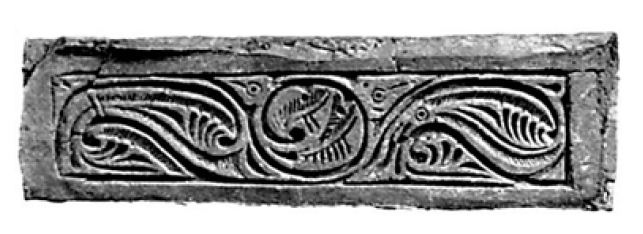
Picture No. 9: Plaster from Neishabur's Sabzposhan hill, source: Mohammadi, Dini, 2017
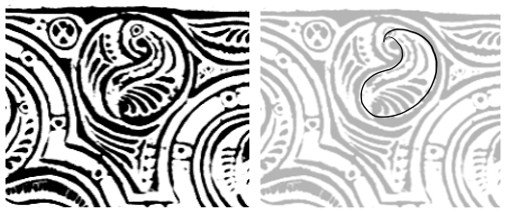
Picture No. 10: Plaster from Neishabur's Sabzposhan hill, source: Mohammadi, Dini, 2017
Geometric ivy is used to draw this pattern in the green-covered plasters. Such a combination of birds and scroll decorations shows the influence of Iranian decorative motifs in the art of the Abbasid period. This role reached perfection in the Seljuk period; Of course, sometimes this is a role It is the opposite, that is, the bird's head is at the end of the palm leaf (picture 11).
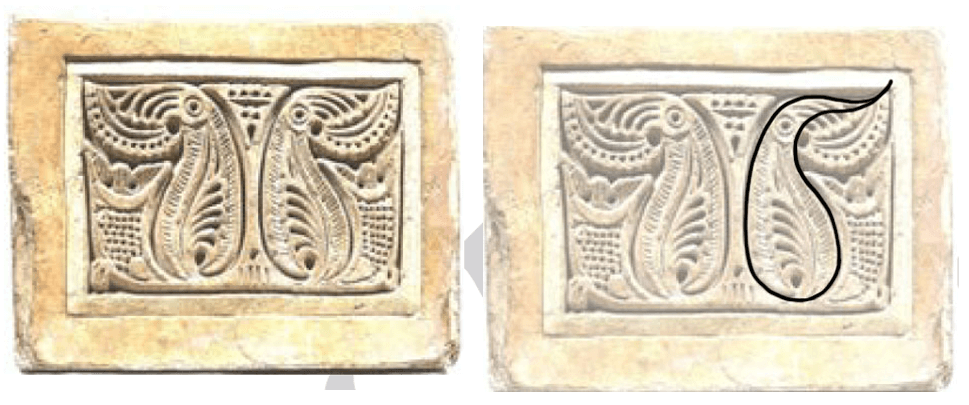
Picture No. 11: Plaster from Neishabur's Sabzposhan hill, source: Mohammadi, Dini, 2017
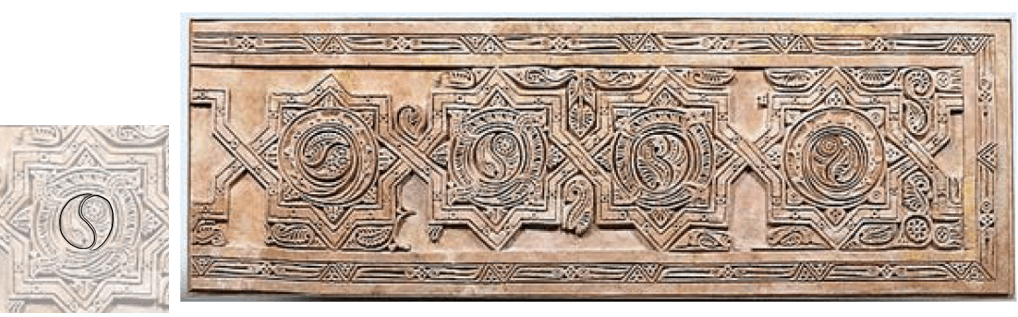
Picture No. 12: Plastering from Neishabur green hill, the presence of Bete Jaqe motif in the plastering, source: Mohammadi, Dini, 2017
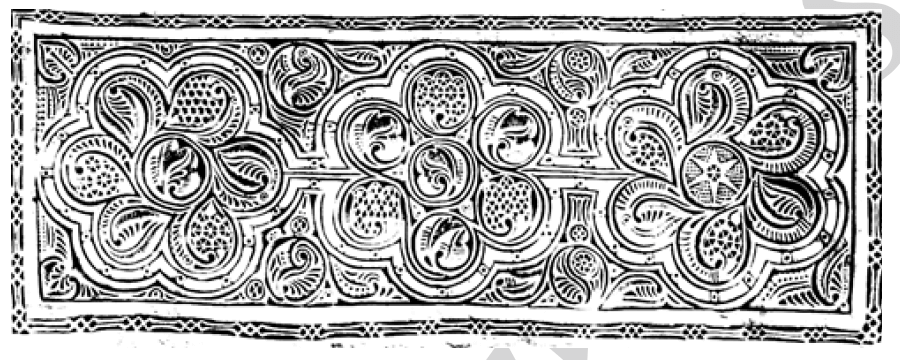
Picture No. 13: Plaster from Neishabur's Sabzposhan hill, source: Mohammadi, Dini, 2017
The plasterwork of Simre Mosque was directly inspired by the decorative motifs of the Sasanian plasterwork, as well as the creation of decorative arrays inspired by the same motifs, i.e. different types of palm leaves, artichoke leaves, etc., and placing them in geometric frames of different shapes, which themselves played an important role in creating symmetry and movement, a sign of imitation and transformation in the artistic rules of plasterwork decorations of the period. It is Sassanid (shape and form).
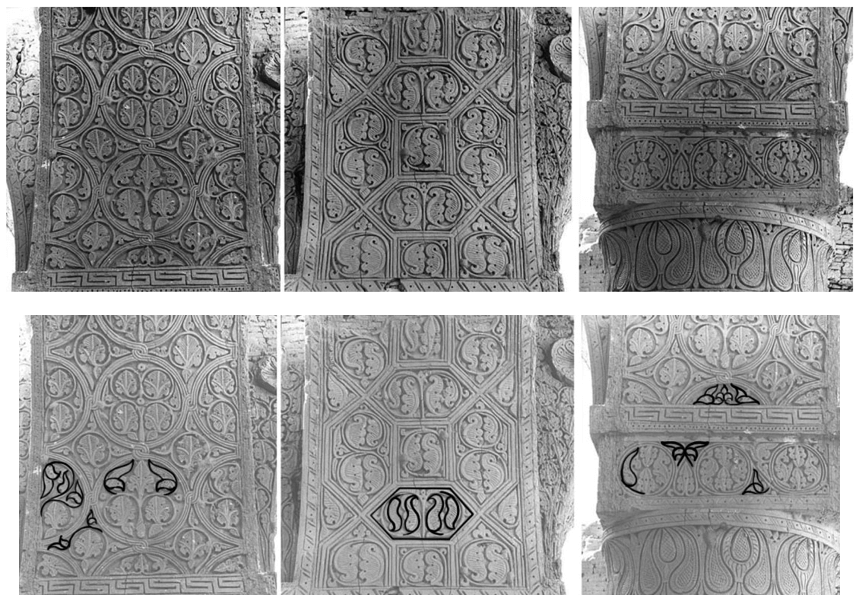
Picture No. 14: Examples of the plaster decorations of the Nine Dome Mosque of Balkh, the end of the second century Hijri. https://archnet.org/sites/3921/media_contents/43804
The most important features of Balkh Nine Dome Mosque are its plaster decorations. The decorative motifs of the plasterwork of this mosque are geometric designs and plant shapes (Naji, 2016, 396). The principle of symmetry and repetition of motifs is one of the most important decorative features of Balkh mosque's stucco motifs (image 14). In this mosque, the early Islamic style can also be seen.
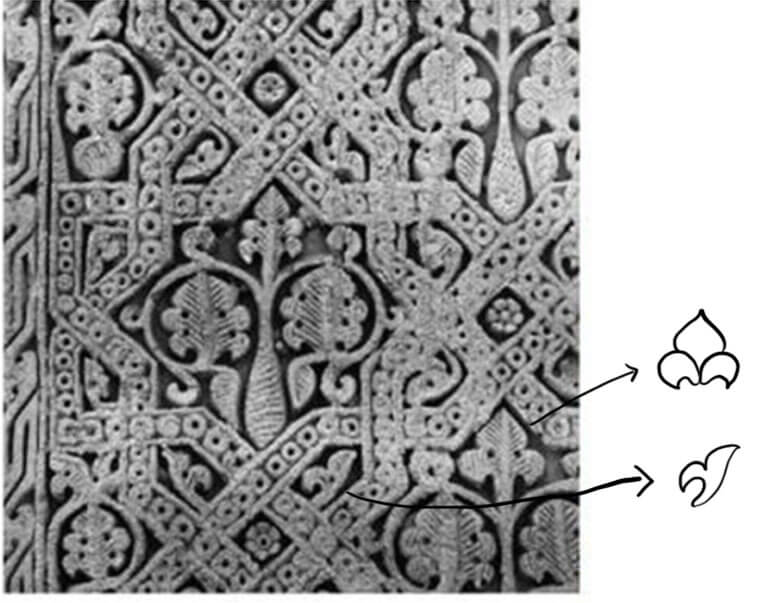
Picture No. 15: Examples of the plaster decoration of Balkh Nine Dome Mosque, late second century Hijri, the leaves of two branches can be considered as simple salami, source: https://archnet.org/sites/3921/media_contents/43792
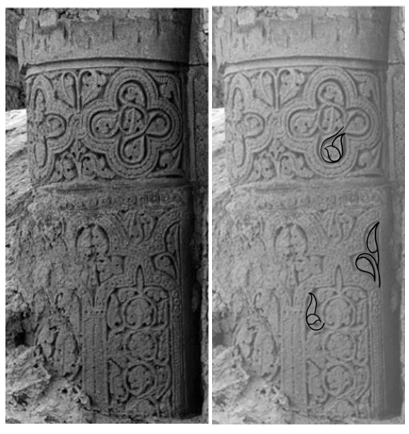
Image No. 16: Examples of plaster decorations of the nine-gomb mosque of Balkh, late second century Hijri, simple slime in the shape of a two-branched leaf, source: https://archnet.org/sites/3921/media_contents/43807#item_description
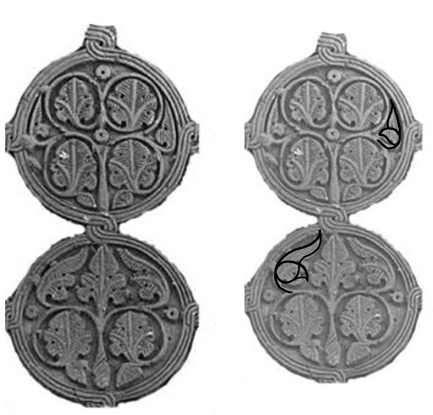
Picture No. 17: Examples of plaster decorations of Balkh Nine Dome Mosque, late 2nd century Hijri, early Islami in the form of a two-branched leaf, source: https://archnet.org/sites/3921/media_contents/41990
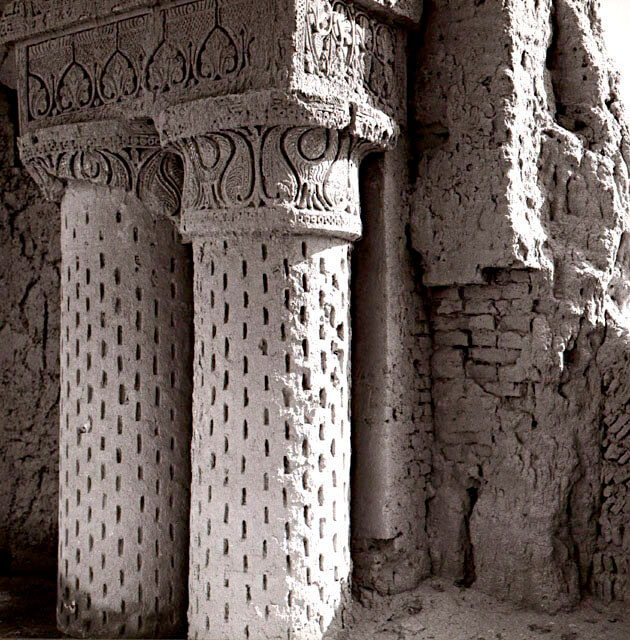
Image #18: Columns of the southeast wall of Balkh's Nine Dome Mosque, Salimi's motif can be clearly seen, source: https://archnet.org/sites/3921/media_contents/41995
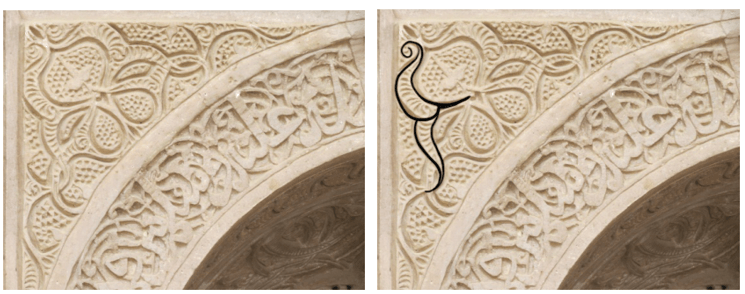
Picture No. 19: Lakhki of the exterior arch of the Niriz Mosque, the first Islamic centuries, the Islamic pattern can be seen here, source: Tagvinejad, Muezni, 2015
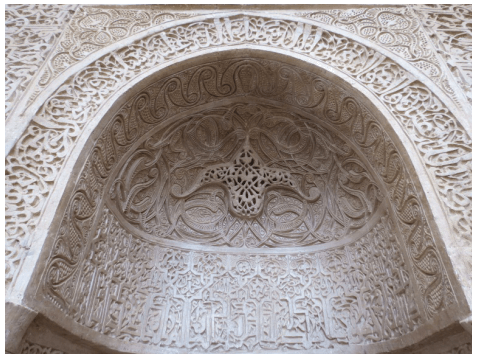
Picture No. 20: Part of the side and front view (interior space of the archway) of the Niriz Mosque, the first Islamic centuries, source: Taghavinejad, Muezni, 2015
Picture No. 21: Under the arch of the arch (Salimi head with hollow mesh) of the Niriz Mosque, the first Islamic centuries, source: Taghvi Nejad, Muezni, 2015
The stucco motifs of these mosques are a combination of geometric motifs (geometric frames) and plants. The principle of symmetry and repetition is the main feature of these motifs. In these decorative surfaces, similar to the decorative surfaces of the plasterwork of the ninth dome mosque in Balkh and Samarra, a trend from realistic motifs to abstract motifs can be seen. Based on this, each of the plant species of Simreh Mosque, while being influenced by the plant motifs of the Sassanid era, has been simplified and linked to complex species in relation to other motifs, which can be considered as the beginning of the creation of Islamic motifs in Islamic art.
The similarity of the decorative motifs used in the plaster decorations of the Simre Mosque with the plaster decorative motifs of the Samara Mosque shows the influence of Iranian art, according to historical evidence.
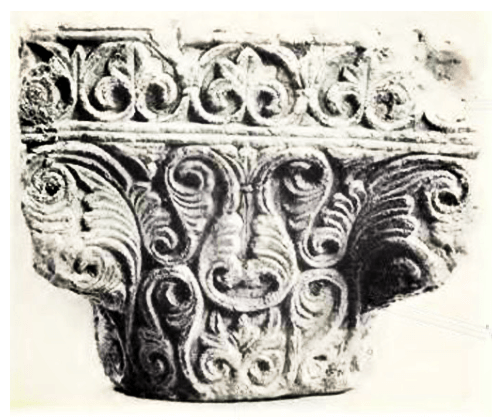
Picture No. 22: Samara Mosque, Salimi pattern, which is quite similar to the patterns of Nine Gonbad and Simera Mosques, source: Mobini et al., 2017
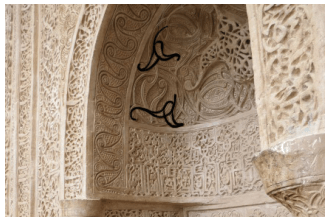
Little by little, the works of the Seljuk period are approaching the slim form that we see today (picture 23) and this role has changed over time during different eras. and decorations were added to it, which can be referred to the remaining works of the Safavid period. that in various arts of illumination and painting, etc., various Islamic motifs have been used (image 26).
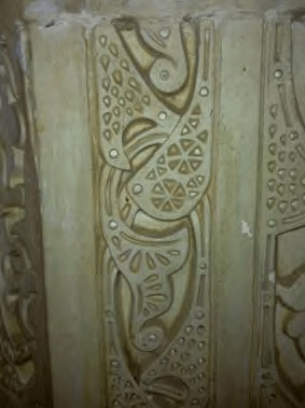
Picture No. 23: Slimy covered in the edge of the altar, Urmia Grand Mosque, Seljuk period, source: Motfekrazad, Zakawt, 2017
In the plasterwork of the Seljuk era, which is a continuation of pre-Islamic motifs. More variety is obtained and since the dimensions of the building are smaller, the decorations are also more delicate. Seljuk plasterwork and in continuation of that period of Ilkhans show excellent examples of variety and beauty (image 24).
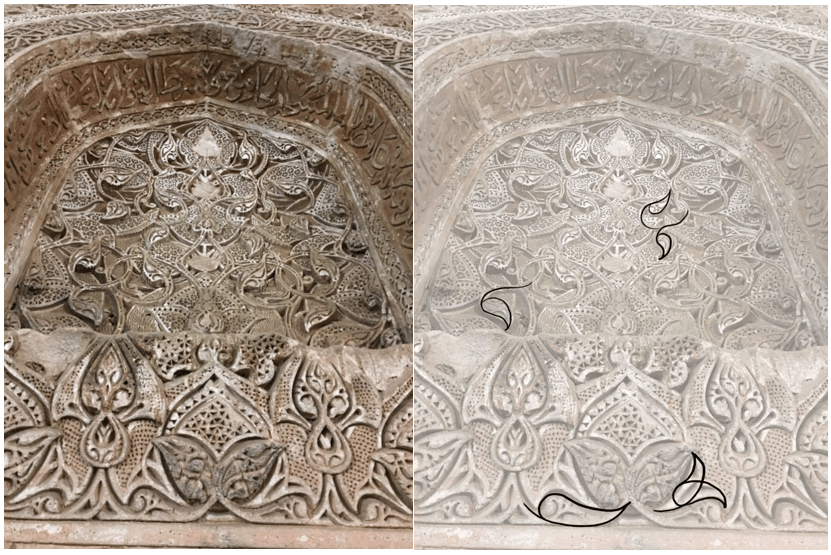
Image No. 24: Mihrab of Marand Jame Mosque in Urmia, Ilkhani period, Salimi motif can be seen in these plasters, source: https://lastsecond.ir/attractions/6393-marand-jame-mosque#gallery-8019-8
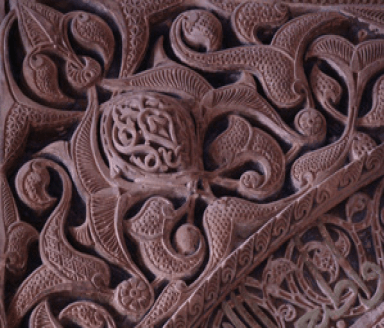
Picture number 25: Plaster with Salimi motifs, Al-Jayto Mihrab, source: Rice, 2016
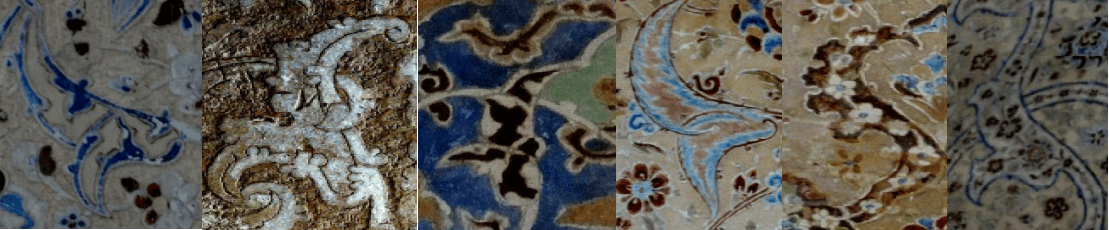
Picture No. 26: Different types of slime on the floors of Aali Qapu Palace, Safavid period, source: Amin Al-Raaya, 1399
conclusion
The role of Eslimi has existed in the traditional arts of Iran since the distant past, but it was not referred to before the Safavid era. Although plant motifs are still called Islamic in many sources, what is known as Islamic motifs is a leaf and a branch whose simple and primitive examples existed in pre-Islamic stucco and later in the stucco decorations of mosques and other buildings of the Islamic era, it can be seen in an evolved form.
The investigation and evolution of this role from the Sassanid era to the Safavid period has been considered in this research. Many mosques of the Seljuk period and before are decorated with this pattern. Repetition, diversity and evolution of Islam is related to the Safavid period, which can be seen in tiling, carpet pattern, fabric and many decorative motifs of this era; And Salimi's name is also mentioned in this role. So far, many articles have been written about Eslimi, the summary of which is given in the book Eslimi and Signs. In this article, the content of the book has been criticized Remove ambiguities and wrong, irrational and emotional opinions.
A group of theoreticians and especially the spectrum of traditionalists have expressed some issues, including the role of Islam, which is very suspicious and has logical flaws and objections about the motifs and symbols in the art of the Islamic era of Iran and the world. Examining the historical course of Eslimi's role in Iran's decorative motifs from the Sassanid to Safavid periods, based on the images, showed that Eslimi is a special motif - two-branched leaf - and has a plant and natural origin. Therefore, strange and sometimes poetic and emotional interpretations and attributing Salimi to mystery and all kinds of contradictions are fundamentally flawed. Referring to Salimi images and its types from the Sassanid to Safavid period clearly shows a role. Naqsh Eslimi or the two-branched leaf whose stem and root are known as Eslimi band and moves with a spiral rotation.
Author: Negin Khosroviani
Footnote
1: Arabesque
2: Cypress is a cone-shaped and evergreen tree that is very tall. This tree is also called Sehi Sehi and Saronaz. Although slimy from the face It is nature and matter.
3: Refer to: Javadi, Shahreh, Bagh Nazar, landscape painting in Iranian painting, number 1.
Mansouri, Timuri, Firouze Islam scientific-research publication, criticism of the views of contemporary traditionalists in the field of Islamic art and architecture, relying on the concept of tradition in the definition of Islamic architecture, number 1.
List of sources
Iskanderpour Khorrami, Parviz (2017),Slimy and signs, carpet, tile, illumination, 5th edition, Awqaf and Charitable Affairs Organization Publications, Tehran.
Azami, Zahra, Sheikh Al-Hakmai, Mohammad Ali, Sheikh Al-Hakmai, Taher, 1392, a comparative study of the plant motifs of the plasters of the Tisphon Palace with the first mosques of Iran.Fine arts magazine, volume 18, number 6, pages 15 to 24.
Amin al-Raaya, Maryam (2019), investigation of slime samples in the floors of Ali Qapu Palace based on Isfahan wall painting.Islamic art magazine,Volume 7, Number 19, Pages 87-99.
Panjeh Bashi, Elaha, Dolab, Fatemeh (2016), study of Siraf plant motifs in the Sasanian period,Jaloh magazine art, year 9, number 2 (series: 18), pages 21 to 38.
Tagwenejad, Bahareh, Moezni, Maryam (2015), a research on the plant and geometrical arrays of the plaster altar of Jamia Niriz mosque.A scientific and promotional quarterly magazine of Islamic art, third volume, number 11, pages 76 to 88.
Hosseini, Seyyed Hashem, Yusufund, Yunus, Miri, Farshad (2014), a comparative study of exposed stucco patterns from the historical city of Simre with examples of Nain Mosque.Two scientific quarterly magazines, promoting art research, year 5, number 9, pages 71 to 85.
Kharai, Mohammad (1375), Kufi script and Salimi motifs.Art and architecture magazine, No. 31, pages 137 to 142.
Rice, Talbot (1386),The heritage of Iranians, translated by Ahmad Birshak, Scientific and Cultural Publications, Tehran.
Zamani, Abbas (1352), Arbesque and Eslimi design in Islamic historical works of Iran,Art and People Magazine, No. 126, pages 17 to 34.
Lyman, Oliver (2015),An introduction to Islamic aesthetics.Translated by Mohammad Reza Abul Qasimi, Publications Fish, second edition.
Lakpur, Simin (2008),Archaeological excavations and researches of Dareh Shahr, Pazineh Publishing House, Tehran.
Motafkerazad, Maryam, Zakavot, Sahar (2017), visual reflection of Islamic art in Urmia Grand Mosque (examination of the altar decorations of Urmia Grand Mosque),Bi-monthly scientific journal specialized in research in humanities and humanities.Year 3, Number 6, Pages 11-22.
Mashbaki Esfahani, Alireza, Safaei, Narges (2015), the development of plant motifs in early Islamic art, Islamic Art Magazine, volume 3, number 10, pages 32-40.
Mohammadi, Maryam, Dini, Azam (2017), the influence of Sassanid period decorative motifs on the architectural decorations of early Islamic buildings in Neishabur.Iranian Archaeological Research Journal, volume 8, number 17, pages 221 to 241.
Mobini, Mehtab, Shakrami, Tayyaba, Sharifinia, Akbar (2017), a comparative study of the plaster decorations of the Simreh Mosque with the nine dome mosques of Balkh and Samarra from the Abbasid period.Journal of fine arts, visual arts, Volume 23, Number 1, Pages 61 to 72.
Naji, Mohammad Reza (2008),Islamic culture and civilization in the Samanid territory, Amirkabir, Tehran.